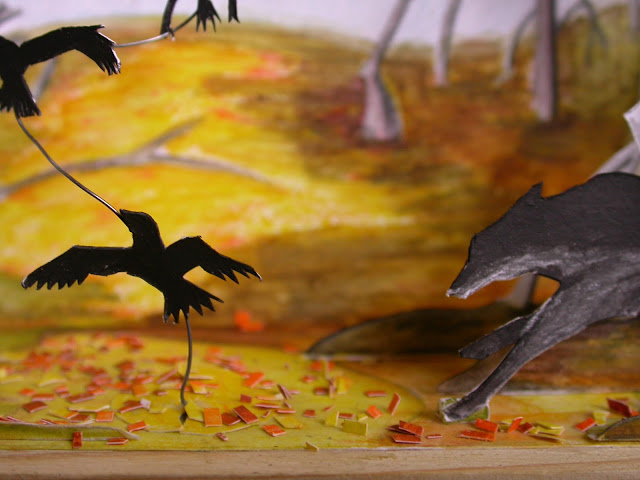
Todos conocemos la historia de Caperucita Roja, forma parte de nuestro universo infantil. Hay numerosas versiones donde el Lobo termina escarmentado, huyendo o incluso muerto a manos de un leñador que rescata a la pobre Caperucita y su abuelita tras ser engullidas. Sin embargo, la historia original proviene de la tradición popular y fue recogida por Charles Perrault hace más de 300 años (Cuentos de Antaño). Por aquel entonces las historias que se contaban a los niños no se limitaban al entretenimiento, traían consigo una moraleja que pretendía aleccionarlos o avisarles de los posibles peligros que podían encontrarse en el mundo exterior. Si era necesario, se utilizaban historias duras e incluso crueles donde los protagonistas sufrían las cosecuencias de sus errores. No se tenía tan en cuenta la sensibilidad de los infantes, ya que en muchos casos se buscaba crear miedos y aprensiones en ellos para evitar de este modo que se acercaran a los focos del peligro (el Hombre del Saco, El Lobo Feroz, La Bruja del Bosque... personificaciones de "extraños" que quieren dañar a los niños, raptarlos, comerselos, etc).
Sin embargo los Hermanos Grimm reunieron de nuevo estas historias, incluyendo algunas de la Europa Central, modificando algunos de los finales o incluso eliminando partes de la historia que podían resultar demasiado duras o aterradoras para los niños de la sociedad victoriana. Esto sucedió por ejemplo con el cuento de los hermanos Hansel y Gretel. Hoy nos explican que se perdieron en el bosque, cuando la historia original contaba que fueron sus padres quienes los abandonaron en la espesura al no tener forma de alimentarlos (de ahí que estuvieran demasiado delgados para la bruja que después quieres comérselos).
En el caso de la famosa Caperucita, la historia original no la salva de su confianza en el desconocido Lobo y acaba siendo engullida junto con su abuelita. El leñador que las rescata en el último momento es un añadido posterior para evitar un destino tan cruel. La moraleja que acompañaba este cuentecito rezaba así:
"Vemos aquí que los adolescentes y más las jovencitas
elegantes, bien hechas y bonitas, hacen mal en oír a ciertas gentes, y
que no hay que extrañarse de la broma de que a tantas el lobo se las
coma. Digo el lobo, porque estos animales no todos son iguales: los hay
con un carácter excelente y humor afable, dulce y complaciente, que sin
ruido, sin hiel ni irritación persiguen a las jóvenes doncellas,
llegando detrás de ellas a la casa y hasta la habitación. ¿Quién ignora
que lobos tan melosos son los más peligrosos?".
Evidentemente Perrault quiso dar una lección moral contra las
jóvenes que entablan relaciones con desconocidos, haciendo especial incapié en el carácter sexual en el que pueden desembocar ciertas actitudes.
Aquí adjuntamos el cuento original, para los nostálgicos y poco melindrosos:
Había una vez una niñita en un pueblo, la más bonita que jamás se
hubiera visto; su madre estaba enloquecida con ella y su abuela mucho
más todavía. Esta buena mujer le había mandado hacer una caperucita
roja y le sentaba tanto que todos la llamaban Caperucita Roja.
Un día su madre, habiendo cocinado unas tortas, le dijo.
-Anda a ver cómo está tu abuela, pues me dicen que ha estado enferma;
llévale una torta y este tarrito de mantequilla.
Caperucita Roja partió en seguida a ver a su abuela que vivía en otro
pueblo. Al pasar por un bosque, se encontró con el compadre lobo, que
tuvo muchas ganas de comérsela, pero no se atrevió porque unos
leñadores andaban por ahí cerca. Él le preguntó a dónde iba. La pobre
niña, que no sabía que era peligroso detenerse a hablar con un lobo,
le dijo:
-Voy a ver a mi abuela, y le llevo una torta y un tarrito de
mantequilla que mi madre le envía.
-¿Vive muy lejos? -le dijo el lobo.
-¡Oh, sí! -dijo Caperucita Roja-, más allá del molino que se ve allá
lejos, en la primera casita del pueblo.
-Pues bien -dijo el lobo-, yo también quiero ir a verla; yo iré por
este camino, y tú por aquél, y veremos quién llega primero.
El lobo partió corriendo a toda velocidad por el camino que era más
corto y la niña se fue por el más largo entreteniéndose en coger
avellanas, en correr tras las mariposas y en hacer ramos con las
florecillas que encontraba. Poco tardó el lobo en llegar a casa de la
abuela; golpea: Toc, toc.
-¿Quién es?
-Es su nieta, Caperucita Roja -dijo el lobo, disfrazando la voz-, le
traigo una torta y un tarrito de mantequilla que mi madre le envía.
La cándida abuela, que estaba en cama porque no se sentía bien, le
gritó:
-Tira la aldaba y el cerrojo caerá.
El lobo tiró la aldaba, y la puerta se abrió. Se abalanzó sobre la
buena mujer y la devoró en un santiamén, pues hacía más de tres días
que no comía. En seguida cerró la puerta y fue a acostarse en el lecho
de la abuela, esperando a Caperucita Roja quien, un rato después,
llegó a golpear la puerta: Toc, toc.
-¿Quién es?
Caperucita Roja, al oír la ronca voz del lobo, primero se asustó, pero
creyendo que su abuela estaba resfriada, contestó:
-Es su nieta, Caperucita Roja, le traigo una torta y un tarrito de
mantequilla que mi madre le envía.
El lobo le gritó, suavizando un poco la voz:
-Tira la aldaba y el cerrojo caerá.
Caperucita Roja tiró la aldaba y la puerta se abrió. Viéndola entrar,
el lobo le dijo, mientras se escondía en la cama bajo la frazada:
-Deja la torta y el tarrito de mantequilla en la repisa y ven a
acostarte conmigo.
Caperucita Roja se desviste y se mete a la cama y quedó muy asombrada
al ver la forma de su abuela en camisa de dormir. Ella le dijo:
-Abuela, ¡qué brazos tan grandes tienes!
-Es para abrazarte mejor, hija mía.
-Abuela, ¡qué piernas tan grandes tiene!
-Es para correr mejor, hija mía.
- Abuela, ¡qué orejas tan grandes tiene!
-Es para oírte mejor, hija mía.
-Abuela, ¡qué ojos tan grandes tiene!
-Es para verte mejor, hija mía.
-Abuela, ¡qué dientes tan grandes tiene!
-¡Para comerte mejor!
Y diciendo estas palabras, este lobo malo se abalanzó sobre Caperucita Roja y se la comió.
Fin.
We all know the story of the Little Red Riding Hood, it is part of our childhood. There are many different versions of this story. There are those where the Big Bad Wolf ends up vexed, fleeing or even killed by the lumberjack, who rescues the poor Little Red Riding Hood and her
"swallowed" grandmother.
However,
the original story is more than 300 years old and comes from popular tradition. Such tales and stories were collected by
Charles Perrault. At
that time, the stories were not told to children as entertainment. They were passed unto the young ones to warn of the possible dangers that could be found in the world. If necessary, they used harsh and even cruel stories where the protagonists often would find terrible consequences for their mistakes. There was no such thing as considering the sensitivity of the infants. It was actually sought to create fear and apprehension in them. This could thus help them to identify where there was danger (The Bogey Man, The Big Bad Wolf, The Witch from the Forest ... they are all personifications of "outsiders" who want to harm children, kidnap them, eat them, etc).
The Grimm Brothers brought back to life these stories and many others from Central
Europe. They changed some endings or even emoved some parts that could be too strong or scary for the Victorian society children. This happened for example with the story of Hansel and Gretel. Today the story is told as children that got lost in the forest. However, the original story is about the survival in the wild of abandoned children by their parents which had no possibility of feeding them (that is why they were too thin for the witch to eat them).
In
the case of the famous Little Red Riding Hood, the original story is ment to avoid trusting people you don't know. The woodcutter, who rescues them in the last minute from a horrible death, was an added character. In this way their cruel fate was avoided. The story is accompanied by the following moral:
"We
see here that elegant and beautiful adolescent girls are worng to trust everyone. They should not be surprised if the wolf will eat them. We say the wolf because these animals are different: some have an excellent character and good sense humor. They are sweet and stlak in silence, they come from behind into the house and
into the room. Who would say that these mellow wolves are the most dangerous ones? ".
Perrault
used this story to give a moral lessons against relationships with strangers, with special stress upon the sexual nature.
Here is the original story for the nostalgic:
Once upon a time there
was a little girl in a village, the prettiest creature ever seen. Her mother was crazy about her. She was her grandmother greatest love. The good woman had a red riding hood and everyone called her Little Red Riding Hood.One day her mother, having baked a cake, said.-Go see how your grandmother, for I hear she has been sick. Take her some cake and this little pot of butter.The Little Red Riding Hood set out immediately to meet her grandmother who lived in another village. Passing through the forest, she found a wolf, who longed to eat her, but didn't dare to because some lumberjacks were working nearby. The wolf asked where she was going. The poor girl did not know if it was dangerous to talk to a wolf, said:I'm going to see my grandmother and bring her some cake and a little pot of butter.- Does she live far away? -Asked the wolf.- Oh, yes! Said the Little Red Riding Hood. Beyond that mill, in the first house in the village.'Well,' said the wolf, I also want to visit your grandmother. I'll go this way and go you that way. We'll see who gets there first.The
wolf ran at full speed down the path that was shorter and the girl linguered in the longest one picking up fruits, running after butterflies and
gathering flowers. Little took the wolf to arrive to the Grandmother's house: Knock, knock.- Who is it?-It
is your grandaughter, the Little Red Riding Hood. Said the wolf disguising his
voice. I bring you some cake and a little pot of butter.The good grandmother, who was in bed not feeling well, shouted:- The door is opened.The wolf opened the door. He jumped over the good old woman and ate her up in a heartbeat. He had been three days without food. He
then shut the door and went to Grandma's bed. He waited for Little
Red Riding Hood who, a bit later, knocked at the door: knock! knock!- Who is it?It's Little Red Riding Hood. She heard the voice of the wolf. At first she felt scared, but she thought the grandmother must have caught a cold:
-It is your grandaughter Little Red Riding Hood, I bring you some cake and a little pot of butter.The wolf shouted, softening his voice a bit:- Enter, the door is opened.The Little Red Riding Hood pulled opened the door.
-Put the cake and the little pot of butter upon the stool, and come into bed with me.The Little Red Riding Hood undressed and got into bed and was very surprised to see the grandmother's shape in her nightshirt. She said:'Grandmother, what big arms you have!-To better hug you, my daughter.'Grandmother, what big legs you have!-To better run, my child.- Grandmother, what big ears you have!-To better to hear you, my daughter.-Grandma, what big eyes you have!-To better see you, my daughter.-Grandma, what big teeth you have!- To better eat you!And saying these words, the wicked wolf pounced on Little Red Riding Hood, and ate her.The End